
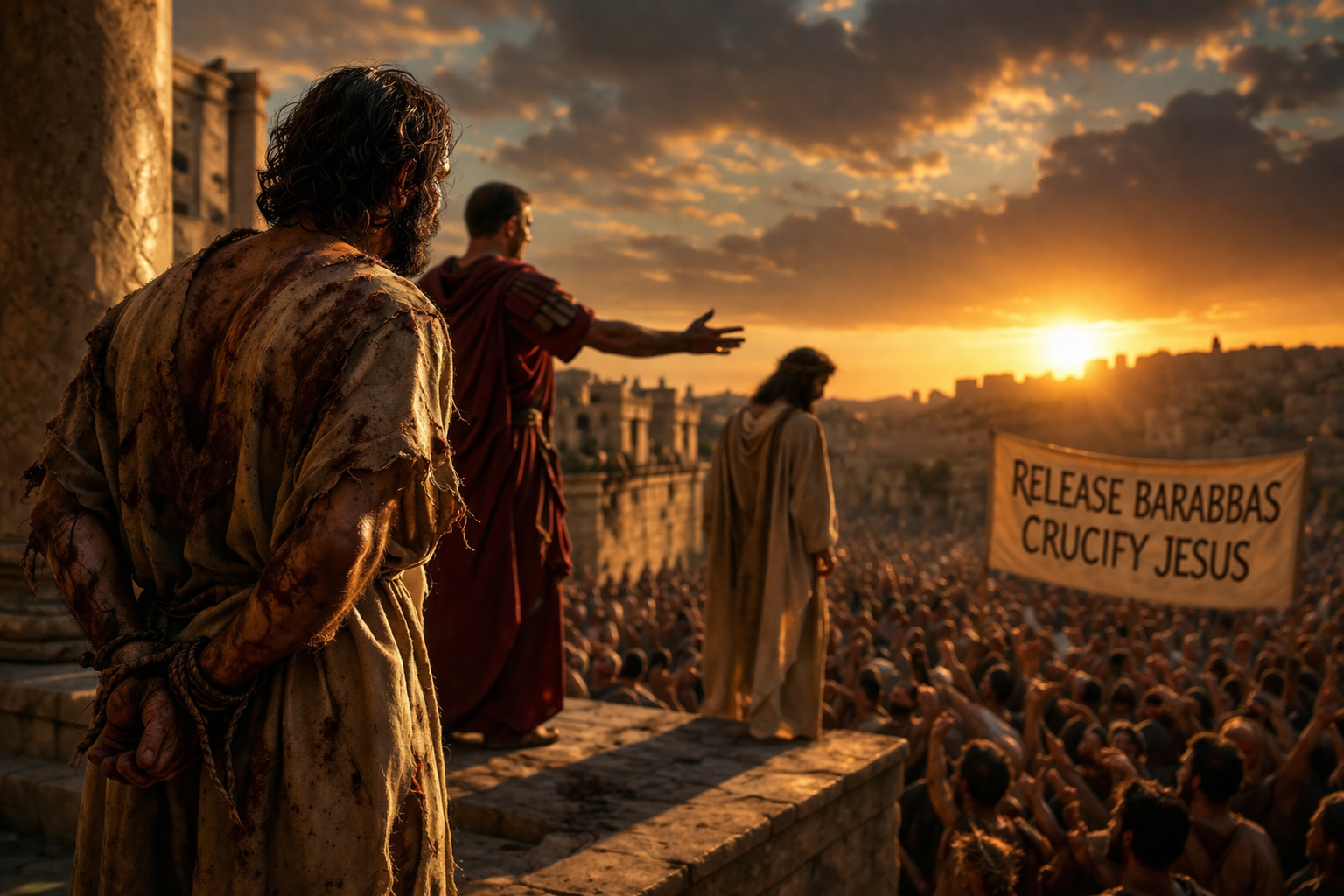
(Matthew 27:15–26; Mark 15:6–15; Luke 23:18–25; John 18:39–40)
There is an old expression about choosing “the devil you know.” It speaks to something deeply human: we often prefer what is familiar, even when it is broken, over what is unfamiliar, even when it is good.
That may be part of what makes the story of Barabbas so haunting.
Why Barabbas Felt Like the Safer Choice
On the day Jesus stood before the crowd, Pilate offered them a choice. He could release Jesus, or he could release Barabbas. The crowd chose Barabbas.
At one level, the scene is shocking. Barabbas was not a harmless man. The Gospels describe him as a criminal, an insurrectionist, and a murderer. He was a man shaped by the logic of violence. He had most likely risen up against Rome as a sort of freedom fighter. Something the people expected from a Messiah. He embodied a kind of power people understood. He made sense in a world ruled by fear, oppression, and force.
Jesus did not.
Jesus stood before them without weapons, without threats, without retaliation. He did not resist. He did not fight for himself. He did not perform the kind of strength they were looking for. He stood there in humility, truth, and surrender. He turned the other cheek.
And that, perhaps, is part of why Barabbas felt like the safer choice.
Not because he was better.
Because he was easier to understand.
Barabbas represented the kind of deliverance people often trust: visible power, immediate action, forceful resistance. He fit the categories of a world that believes salvation comes through strength, dominance, and striking back. He looked more practical. More realistic. More useful.
Jesus represented something else entirely.
He offered no sword.
No uprising.
No revenge.
No spectacle of domination.
He came with mercy, truth, enemy-love, and a kingdom that does not advance by crushing others. He came with a kind of power that does not look like power at all. And that is what made him so difficult to receive.
The Power We Recognize and the Power We Resist
The crowd chose the power they could recognize over the love they could not yet understand.
That is what makes this story more than an account of a terrible moment in history. It is a revelation of the human heart. We would like to believe that, had we been there, we would have chosen differently. But the story is not merely about their blindness. It is about ours too.
We still struggle to trust the quiet strength of Jesus.
We still prefer visible power to humble truth.
We still confuse force with effectiveness.
We still assume that loudness is strength and gentleness is weakness.
We still gravitate toward what feels immediate, familiar, and controllable.
We say we want peace, but often trust aggression.
We say we want healing, but often cling to resentment.
We say we want Christ, but are often more comfortable with the ways of Barabbas than the way of the cross.
That is what makes Good Friday so piercing.
The crowd did not just reject Jesus.
They preferred another kind of saviour.
They chose a man who mirrored the world they knew over the One who came to redeem it.
And yet, the story does not end with their choice. It deepens with Jesus’ choice.
Because this is not only a story about the power we prefer.
It is also a story about the mercy God gives.
The Guilty Go Free
Barabbas goes free.
Jesus is condemned.
The guilty man walks away.
The innocent man takes his place.
That is not a side note in the Passion narrative. It is one of its clearest pictures. Barabbas becomes, in a single moment, a living image of substitution. The one who deserves judgment is released, and the righteous one is led away to die.
This is the mystery at the center of Good Friday:
the guilty spared,
the innocent condemned,
the holy one standing where the rebel should stand.
Barabbas is not only a character in the story.
He is a mirror.
He is every person who has benefited from a mercy they did not deserve. Every person who has walked free because another bore the cost. Every person who has preferred false forms of power and still has been loved by Christ.
He is us.
That is why Good Friday is both devastating and beautiful.
It is devastating because it shows us what we are like. We are not naturally drawn to the ways of Jesus. Left to ourselves, we often choose the kind of power that feels familiar. We choose what looks effective. We choose what reassures our instincts. We choose what does not ask us to surrender.
But it is beautiful because Jesus goes to the cross anyway.
He does not die only for the wise, the faithful, or the spiritually perceptive. He dies for the crowd. He dies for the guilty. He dies for those who misunderstand him, resist him, misjudge him, and prefer other saviours.
He dies for Barabbas.
He dies for the ones shouting.
He dies for us.
Good Friday tells the truth about the human heart, but it also tells the truth about the heart of God.
We chose the devil we knew.
Jesus chose the cross.
We reached for the kind of power this world understands.
Jesus revealed a greater power altogether: the power of self-giving love.
And in that love, the guilty are set free.
Journaling Prompt
Where in my life am I still tempted to trust visible power, control, or force more than the quiet way of Jesus?
Breath Prayer
When I reach for lesser power,
teach me the strength of your love.
Practical Application
Pay attention today to one place where you instinctively want control, vindication, or visible strength. Before reacting, pause and ask: What would it look like to choose the way of Jesus here instead of the way of Barabbas?
Accompanying song – https://suno.com/s/DsQWXzKI4t8PZxTm
What do you think?