
Previously, I wrote about how we can lose the gospel without noticing: tweak by tweak, softening the edges, keeping the vocabulary while quietly trading away the substance. That raises the obvious follow-up question: What is the gospel, actually?
I promised I’d follow up with a post answering that question. I’m going to answer as clearly as I can.
The Gospel is good news. If that is true, it is only good if it’s anchored in something real—something that really happened, something that can change the world, something capable of carrying the weight and substance of our lives. It is only good if it provides hope.
The place we long for
We are drawn into stories because they tap into our deepest longings: intimacy (loving and being loved as we are), impact (knowing our life matters), and integrity (an orderly and peaceful world). We ache for a world where things are as they should be.
Revelation 21 paints a vivid picture of a world we have not known yet: God dwelling with humanity, tears wiped away, no more death, mourning and pain gone, and the voice from the throne saying,
Behold, I am making all things new.
Rev. 21:1–7
This isn’t wishful thinking. It’s hope. Because Jesus rose from the dead, the future of “all things new” isn’t fantasy. It’s already begun. Resurrection is the first crack in the wall of the old world.
This place, originally described in Genesis 2, is restored to its fullness and completeness in Revelation 21—the beautiful garden, when properly cared for, becomes a grand city. God created us so he could love us and we could love him. God created us so we could care for the earth, see its fruit, multiply in it, and be creative within it. God created us to be people marked by grace, love, mercy, compassion, and justice—his image, his likeness.
And yet those things have been lost, leaving us thirsty and striving to find them again. We may catch glimpses, but our souls know very well that things are far from being as they should.
The wasteland we are living in
How did we get here? Genesis 3 tells us how. We decided to try things out on our own. We were seduced by our desire to build our own kingdom. Our trust in God faltered.
We have been impacted by sin. We are not only guilty of it, but even more so, we are broken by it. It is in us, in others, it is around us. Even creation suffers from the reality of it.
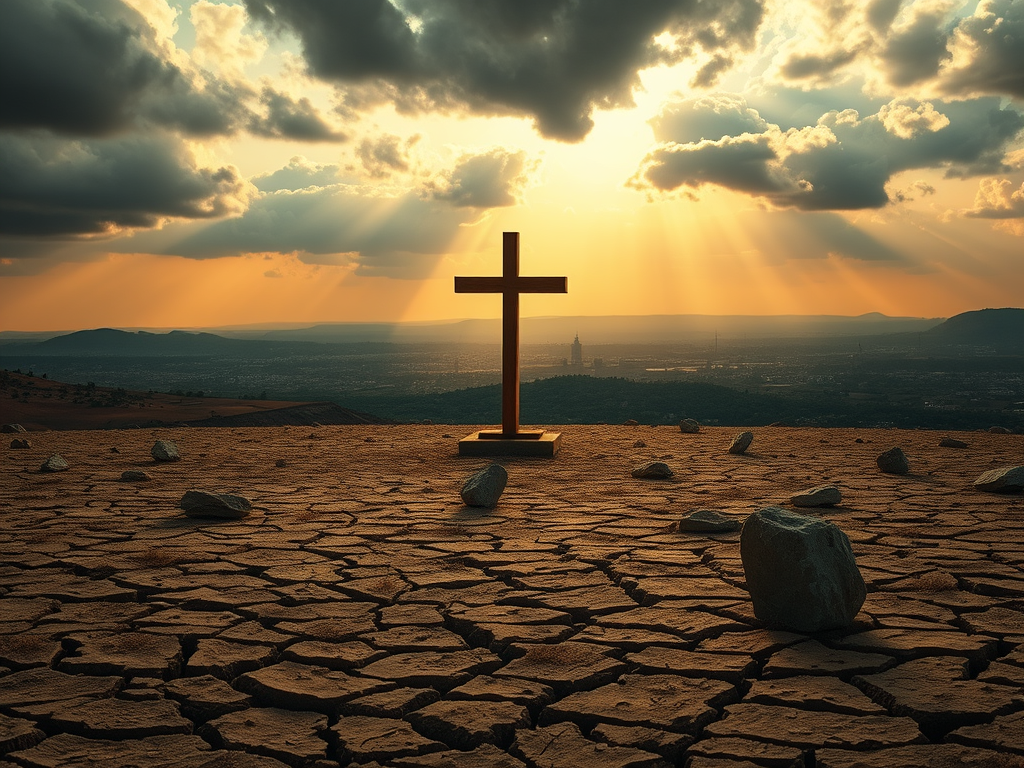
And here’s the center of the gospel: God doesn’t restore the world by ignoring sin, or by flattering us into improvement. God restores the world by entering our mess. The cross is where sin is dealt with; the resurrection is where death is dethroned. The gospel is not God waving at our chaos from a safe distance—it’s God stepping into it, absorbing it, and breaking its power.
Our broken cisterns
Jeremiah 2 speaks of broken cisterns that we fabricate for ourselves—cisterns that cannot hold water, that cannot quench our thirst. We bargain God away in exchange for these cisterns.
Contrary to popular thinking, we don’t stop being religious when we do this. We simply relocate our faith. We might be twisting and tweaking. We keep building alternate kingdoms to quiet the thirst. It sometimes works, but always only momentarily.
So what is the gospel?
The story we find ourselves in is God’s story of redemption and restoration.
Jesus proclaimed the good news and said,
The Kingdom of God is near…
Mark 1:14–15
Jesus does more than announce the Kingdom. He secures it. The Kingdom comes near in his life and teaching, but it is won at the cross and confirmed by the resurrection. If we remove the cross from the centre, we don’t get a gentler gospel. We get a powerless one.
This is the sentence I keep coming back to when I feel the temptation to tweak the message into something “safer”: the gospel is not first what we do for God, but what God has done for us in Christ—crucified for our sin, raised for our hope, and reigning to make all things new.
God, in Jesus, did the ultimate thing. He has always been a missionary God. Motivated by love, God has always moved toward humanity in offer of salvation and relief—throughout the story of Scripture—until, in sending his Son Jesus, he did so once and for all in the greatest of ways, taking on human flesh and life. It has always been his intention to dwell among us and for us to be with him.
One saving center, many benefits
Here’s what I don’t want to lose: all the gifts of the gospel flow from one center. The cross is where mercy and justice meet without pretending sin isn’t real. The resurrection is where life wins without pretending death isn’t brutal.
Many benefits flow out of that one central event.
- Through Jesus, the God of grace and love makes provision for the forgiveness and covering of our sin problem.
- In Jesus, the God of justice provides the means necessary for justice to be restored.
- Through Jesus, the God of mercy and compassion provides what is necessary to heal us from our brokenness.
- In Jesus, God, the creator and sustainer of life, guarantees that the beautiful and wonderful world he created will not go to waste but will also taste redemption.
Through the gift of the Holy Spirit, God the Comforter dwells with us, seals and empowers us so that today, here and now, we may know, taste, and live the reality of a new heaven and a new earth that is to come when Jesus returns.
God offers salvation, life, forgiveness, healing, restoration, to anyone who turns to him in faith—trusting that he is the giver of life and that Jesus is the way, the truth, and the life.
Not an event — a people, a witness, a way
God has called us into his story and invites us to join him.
Until Jesus returns, we are his witnesses, his ambassadors, his representatives, and peacemakers. Our lives give a glimpse of a world to come, a different kingdom… our lives bear witness to the reality that there is salvation, there is hope.
As Jesus said,
You are the salt of the earth … You are the light of the world.
Matthew 5:13-16
As we go into our community, our workplaces, our schools, our families… this is what we are inviting people into—not an event but into our story so that they may discover their own story, find God and be transformed by the Gospel.
Let’s tighten it up a bit
Here’s an attempt at recapping this as tightly as possible:
The gospel is the good news that the God who made the world good has not abandoned it to the ruin of sin and death; he has moved toward us in mercy to redeem and restore what was broken. Jesus announces God’s Kingdom—and then secures it: the cross is where sin is dealt with, and the resurrection is where death is dethroned. Salvation is not only pardon for guilt but restoration from brokenness—so that even creation can be renewed. God gives his Spirit so we can taste the coming world now, and he calls us into his story as witnesses, ambassadors, and peacemakers until the day when God dwells with humanity, tears are wiped away, and death is no more.
Something for today
Where do I avoid the cross because it confronts me, and where do I avoid the resurrection because it demands hope?
Practical application
Name one “tweak” you’ve made (something you’ve softened, avoided, or edited out). Write it down. Then, in one sentence, return to the center: Christ crucified, Christ risen. Say it out loud. Let it offend your pride and heal your fear.
Closing question
Where do you feel most pressure to soften the message—socially, politically, or personally?
What do you think?